
DHS issues final rule changing admission period for foreign students and exchange visitors
minhle
News
The Application for Naturalization is a crucial step in the U.S. citizenship process. However, its complex content and strict disclosure requirements can easily cause confusion for many permanent residents. With practical experience in the field of immigration, First Consulting Group provides a detailed guide on how to complete the Form N-400, Application for U.S. Citizenship, helping permanent residents correctly understand the process, fill out the form accurately, and mitigate risks during the U.S. naturalization adjudication process.
Form N-400 is the official form issued by the U.S. Citizenship and Immigration Services (USCIS) for eligible permanent residents (green card holders) who wish to become U.S. citizens through the naturalization process. This is a comprehensive legal tool that helps USCIS gather and evaluate information regarding:
Form N-400 consists of 18 main parts, each requiring specific information. Below is the guide to completing several critical parts of the application:
Accurately fill out your name, date of birth, and contact information. Pay special attention to the following:
Provide complete details on:
Many applicants wonder: do short trips lasting less than 24 hours need to be declared? The answer is that it is not mandatory, but recommended for full transparency. However, according to USCIS guidelines, every trip outside the U.S. lasting over 24 hours should be fully disclosed to ensure information transparency.
Provide:
This section often causes confusion when the applicant has had multiple job changes or has been married multiple times.
List all children, including:
This is the most critical section. You must truthfully answer questions regarding:
If you answer “Yes” to any question, attach a detailed explanation and supporting documentation.
Good Moral Character is a mandatory requirement for naturalization. USCIS does not only look at criminal records but also evaluates tax compliance, child support payments, Selective Service registration (if applicable), as well as compliance with immigration laws.
Certain severe violations can permanently bar an applicant from naturalization, while other offenses are only evaluated within the statutory period prior to filing the application.

According to the U.S. Immigration and Nationality Act, permanent residents can file for U.S. citizenship when they:
USCIS allows applicants to file up to 90 days early before meeting the required continuous residence milestone (3 or 5 years) calculated from the official “Resident Since” date printed on the Green Card. This helps applicants be more proactive in their naturalization planning.
Applicants who frequently travel back to their home country to visit family, attend traditional holidays, spend summer vacations, or handle personal matters should carefully review each trip, especially the time spent outside the U.S., to avoid affecting their residency requirements.
Certain individuals are eligible for special conditions when filing Form N-400:
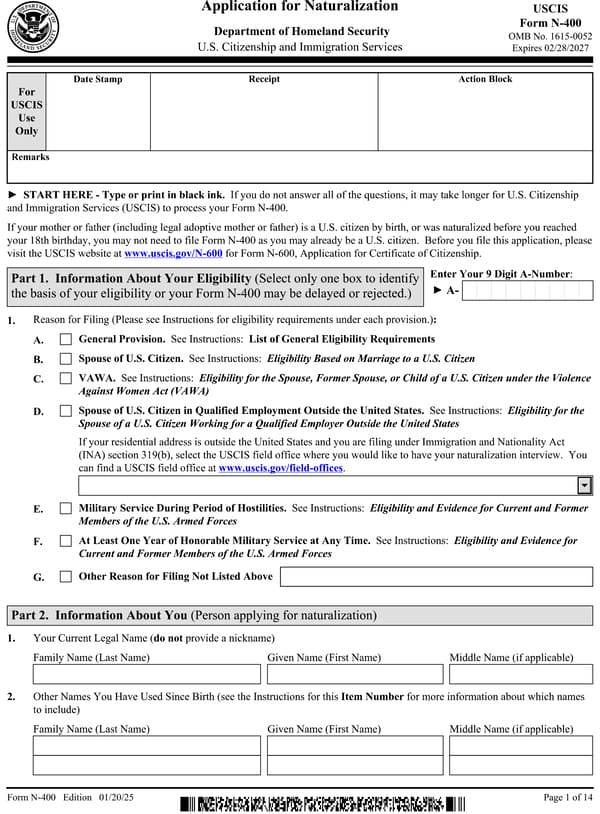
The U.S. naturalization process involves multiple steps and requires the application packet to be fully and accurately prepared from the beginning. Knowing the necessary documents helps the applicant be more proactive during the filing process and minimizes delays during adjudication.
A U.S. citizenship application packet typically includes:
In certain instances, the application may require additional explanations, such as when the applicant has a history of administrative citations, late tax filings, extensive international travel, or has previously received a Request for Evidence (RFE). Preparing sufficient documentation ensures a smoother and faster adjudication process.
You can file your U.S. citizenship application through one of two methods:
Filing online is generally more convenient and makes tracking the case progress easier, whereas complex cases may benefit from a paper filing accompanied by detailed legal explanations.
The naturalization process from filing the application to the Oath Ceremony usually takes about 6 to 10 months, depending on the field office location and individual case specifics. Applicants can check actual processing times for their local office using the official USCIS tool: https://egov.uscis.gov/processing-times/
Current filing fees:
USCIS may adjust fee schedules under new regulations. Therefore, applicants should check the updated fee rates at: https://www.uscis.gov/forms/filing-fees
Please note that fees and processing times are subject to change. Applicants facing financial hardship may file Form I-912 to request a fee waiver or reduction. If applying for a fee waiver/reduction, the application packet must be submitted via paper filing.
Naturalization applications generally progress through the following main milestones:
Case Received → Biometrics Scheduled → Interview Scheduled → Decision Made → Oath Ceremony Scheduled
Note that some applicants may be exempt from a biometrics appointment if USCIS reuses previously captured biometric data.
After filing, applicants can monitor their case status via:
After filing Form N-400, you will receive an interview notice. The interview covers three main components:
The questions typically revolve around U.S. history, government structure, civil rights and responsibilities, as well as geography and national symbols. With proper preparation, applicants with limited English skills can still pass this portion by thoroughly studying the sample questions and practicing short, clear answers.
Depending on the state and local office, the Oath Ceremony may take place on the same day you pass your interview, or you will receive a notice to attend the ceremony on a later date. At the ceremony, the applicant surrenders their Green Card, takes the Oath of Allegiance to the United States, and officially becomes a U.S. citizen.
Upon completion of the Oath Ceremony, a Certificate of Naturalization is issued to confirm your citizenship status. You must safeguard this document carefully for future administrative procedures.

First Consulting Group hopes this article helps you better understand the naturalization process and how to properly prepare your U.S. citizenship application.
Should you require an eligibility assessment, application review, or interview preparation assistance, please contact us for a consultation tailored to your specific circumstances.
FOR A FREE CONSULTATION, PLEASE CALL:
– Hotline: (877) 348-7869
– Garden Grove Office: (714) 638-3111
– San Jose Office: (408) 998-5555
– Houston Office: (832) 353-3535
– Vietnam Office: (028) 3516-2118
Disclaimer: All information provided in this document is intended for general informational purposes only and does not constitute formal legal advice. Statistical data and processing timelines reflect the public records available at the time of publication. For precise legal assessments, please schedule a direct consultation with First Consulting Group.
Top Articles



The U.S. immigration process can be intricate, involving detailed legal requirements and procedures. To better address your unique situation, please provide your contact details to arrange a personalized consultation. A member of First Consulting Group’s dedicated team will contact you during business hours to offer expert guidance.

USA
12966 Euclid St., Suite 520, Garden Grove, CA 92840
(714) 638-3111
USA
989 Story Rd., Suite 8075, San Jose, CA 95122
(408) 998-5555
USA
1880 S Dairy Ashford Rd Ste 539, Houston, TX 77077
(832) 353-3535
VIETNAM
8th Floor, Tuoi Tre Tower, 60A Hoang Van Thu St., Duc Nhuan Ward, SaiGon
(028) 3516-2118
VIETNAM
5th Floor, Bao Minh Building, 08 Phan Van Tri St., Ninh Kieu Ward, Can Tho City
(0292) 383-0001
VIETNAM
5th Floor, Viettel Building, 11 Ly Thuong Kiet St., Thuan Hoa Ward, Hue City
(0234) 381-0016
VIETNAM
6th Floor, ACB Building, 218 Bach Dang St., Hai Chau Ward, Da Nang City
0886 00 34 00