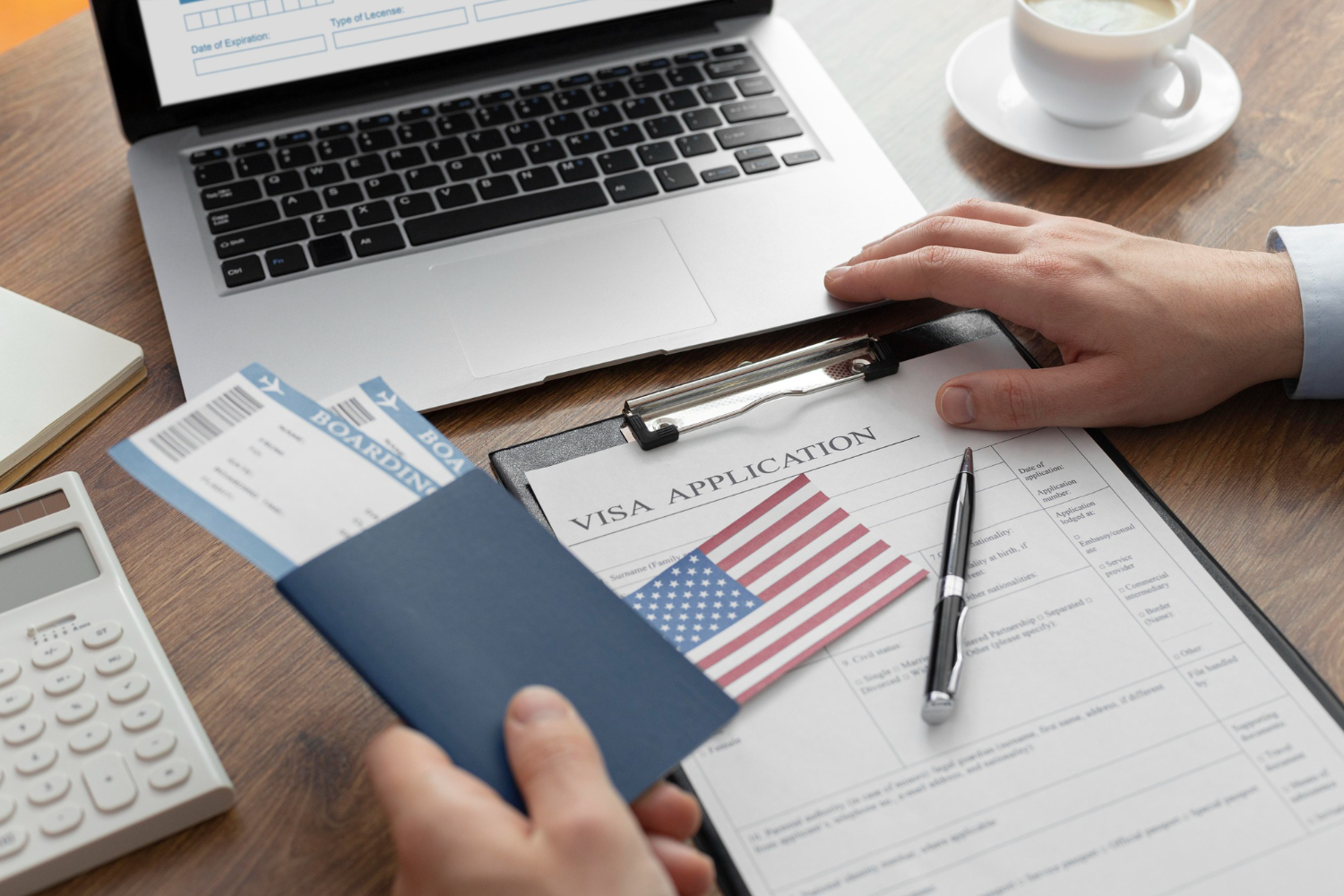
USCIS ISSUES NEW GUIDANCE ON PUBLIC CHARGE INADMISSIBILITY: WHAT APPLICANTS NEED TO KNOW
minhle
News
Family-sponsored petitions play a crucial role in the United States immigration system, offering families the opportunity to reunite and build a new life together. However, many sponsors and beneficiaries often wonder how long the F2B visa process takes, given that the adjudication timeline is lengthy and involves complex legal procedures. To help you better understand this process, First Consulting Group (FCG) provides comprehensive and useful information below. This guide will help you thoroughly prepare your application, minimize Requests for Evidence (RFEs), and expedite your waiting time when sponsoring a child to the United States.
F2B is one of the categories within the Family-Based Immigration program of the U.S. government. This category allows Lawful Permanent Residents (Green Card holders) to sponsor their unmarried sons and daughters, aged 21 or older, to immigrate to the U.S., contributing to the building of communities and family relationships in America.
The estimated processing time for the F2B category (Green Card holders sponsoring unmarried children over 21) is approximately 9 years from the time Form I-130 is filed until the beneficiary’s turn for an interview appointment.
Note: How long the F2B petition takes to process also depends on the country of origin, the status of the visa bulletin, and the completeness of the documentation. For high-demand countries, the waiting time currently tends to be longer due to severe retrogression.
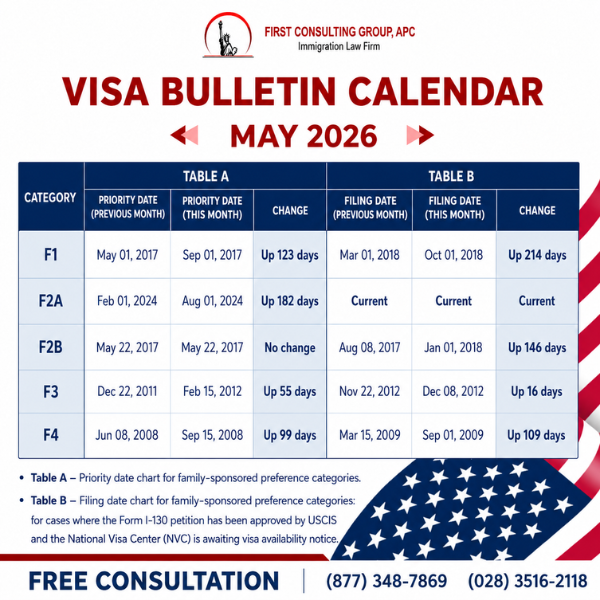
First Consulting Group provides you with the latest update on the F2B category (Permanent Residents sponsoring unmarried children over 21) according to the May 2026 Visa Bulletin published by the U.S. Department of State:
Stage 1: Adjudication of Form I-130 at USCIS takes from 12 to 24 months. After approval, you will receive an I-797 notice with a Priority Date – a crucial milestone that determines your place in line for a visa.
Stage 2: Waiting for a visa is the longest phase, currently lasting from 8 to 11 years depending on the retrogression status. The U.S. Department of State publishes the Visa Bulletin monthly to update which priority dates are being processed. When your priority date is close to being current, the National Visa Center (NVC) will contact you to request application completion.
Stage 3: Processing the application at the NVC takes from 3 to 6 months. You need to submit Form DS-260, pay the visa fee, prepare civil documents, and the Affidavit of Support (Form I-864).
Stage 4: The interview at the U.S. Embassy or Consulate usually takes place within 1 to 2 months after the NVC forwards the file. If the interview is successful, the visa will be issued within 7 to 10 working days.

Important Notes When Completing Form I-130
General Notes
You can track the status of your Form I-130 via the USCIS website using the receipt number found on the Form I-797C. After the case is transferred to the NVC, log into the CEAC portal using your case number and invoice ID number to track progress. The monthly Visa Bulletin published on the U.S. Department of State website helps make it easier to estimate when your turn will come.
Many people confuse the F2A and F2B categories. In reality, there is a major difference between these two categories:
| Criteria | F2A | F2B |
| Target Beneficiary | Spouses and unmarried children under 21 of U.S. Permanent Residents | Unmarried sons and daughters aged 21 or older of U.S. Permanent Residents |
| Processing Time | Approximately 4 years | Approximately 9 years |
| Annual Quota | Minimum of 77% of the total Family 2nd preference quota (about 87,900 visas), with 75% exempt from country caps | About 23% of the total Family 2nd preference quota (about 26,200 visas), flexibly allocated depending on the year |
| Priority Level | Higher priority in visa allocation | Lower priority compared to F2A |
| Visa Retrogression | Occurs frequently from 2023 to present; no longer in “Current” status (always available) as before | Occurs frequently and can retrogress deeper than F2A |
This time difference stems from the U.S. government’s visa allocation policy. The program prioritizes the reunification of spouses and young children. Adult children are considered to have a higher capacity for independence. Backlogs and visa retrogression occur frequently, especially for countries with high numbers of applicants. Many applicants mistakenly believe that when switching from F2A to F2B because the child turns 21, they will retain the exact same timeline, but the priority date is still calculated from the original filing time. Applicants need to monitor the monthly Visa Bulletin to update their specific situation.
Preparing a complete document package right from the start helps avoid situations where the Citizenship and Immigration Services or the NVC requests additional evidence.
The F2B immigration petition only applies to children who are unmarried. If the child gets married during the waiting period, the petition will be instantly revoked at the moment the marriage certificate is issued. Even if they divorce later, the petition remains revoked because this is the strictest regulation of this category.
The sponsor must prove sufficient financial capacity to sponsor the beneficiary. This ensures the beneficiary will not become a public charge after entering the country.
Minimum Income Requirements
The minimum income level is adjusted annually based on the Federal Poverty Guidelines:
Estimated Income for 2026
The required income level is adjusted and increases slightly each year based on inflation rates published by the U.S. Department of Health and Human Services (HHS). Based on the latest data and the increasing trends of recent years, below is the estimate for 2026:
Note: The figures above only apply to the 48 contiguous states and Washington D.C. The required income level will be significantly higher if you reside in Alaska or Hawaii due to higher living costs and specific transportation factors. You must cross-reference with the latest Form I-864P on the official USCIS website to obtain the absolute exact number for the filing year. Form I-864P is updated annually around March or April.
How to Calculate Household Size
When calculating, the sponsor must aggregate:
Solutions When Income is Insufficient
If the income from work does not meet the requirements, the sponsor can:

The sponsor must maintain their permanent resident status throughout the waiting process. If the sponsor abandons their Green Card or no longer resides in the U.S., the F2B petition will no longer be valid.
However, if the sponsor becomes a U.S. citizen during the waiting period, the petition can convert to the F1 category. You need to send proof of naturalization (Naturalization Certificate) to the NVC to update this status.
Important Note on the Visa Bulletin: Before converting from F2B to F1, you should check the monthly Visa Bulletin published by the U.S. Department of State to compare the progress of both categories. In some cases, this category can be faster than F1 due to different application volumes and visa quotas.
If you find that the F1 category is moving slower or holds no distinct advantage, you have the right to perform an “Opt-out” procedure – meaning you request to decline the conversion and retain the original category. To perform an Opt-out, you need to send a written request to the National Visa Center (NVC) or the U.S. Consulate handling your file. Regularly monitoring the Visa Bulletin and consulting with an immigration attorney will help you make the most appropriate decision for your specific case.
Upon entering the United States, the beneficiary receives an Immigrant Visa stamped at the port of entry, which is valid as temporary proof of permanent residency (for 1 year). The official Green Card will be sent via mail within 2 to 4 weeks. As a permanent resident, you have the right to:
Note: You must maintain your primary residence in the U.S. Leaving the United States for more than 6 consecutive months can be considered an abandonment of permanent resident status. Leaving for more than 1 year requires applying for a Re-entry Permit prior to departure.
F2B brings the opportunity for family reunification, but the waiting time extending around 9 years and the complex procedures require careful preparation at every step. With over 23 years of experience in U.S. immigration, First Consulting Group (FCG) – a U.S. Immigration Law Firm – has accompanied thousands of families in successfully completing family sponsorship applications. Our team of attorneys and specialists thoroughly understands every detail of the Form I-130 preparation process, tracking the monthly visa bulletin, completing procedures at the NVC, and preparing for the interview at the Consulate.
If you need further in-depth information regarding how long the F2B petition takes, the documentation, or related services, please contact FCG today for a free consultation and fast, professional support. We are always ready to accompany you on every path to starting a new life in America.
FOR A FREE CONSULTATION, PLEASE CALL:
– Hotline: (877) 348-7869
– Garden Grove Office: (714) 638-3111
– San Jose Office: (408) 998-5555
– Houston Office: (832) 353-3535
– Vietnam Office: (028) 3516-2118
Disclaimer: All information provided in this document is intended for general informational purposes only and does not constitute formal legal advice. Statistical data and processing timelines reflect the public records available at the time of publication. For precise legal assessments, please schedule a direct consultation with First Consulting Group.
Top Articles
The U.S. immigration process can be intricate, involving detailed legal requirements and procedures. To better address your unique situation, please provide your contact details to arrange a personalized consultation. A member of First Consulting Group’s dedicated team will contact you during business hours to offer expert guidance.

USA
12966 Euclid St., Suite 520, Garden Grove, CA 92840
(714) 638-3111
USA
989 Story Rd., Suite 8075, San Jose, CA 95122
(408) 998-5555
USA
1880 S Dairy Ashford Rd Ste 539, Houston, TX 77077
(832) 353-3535
VIETNAM
8th Floor, Tuoi Tre Tower, 60A Hoang Van Thu St., Duc Nhuan Ward, SaiGon
(028) 3516-2118
VIETNAM
5th Floor, Bao Minh Building, 08 Phan Van Tri St., Ninh Kieu Ward, Can Tho City
(0292) 383-0001
VIETNAM
5th Floor, Viettel Building, 11 Ly Thuong Kiet St., Thuan Hoa Ward, Hue City
(0234) 381-0016
VIETNAM
6th Floor, ACB Building, 218 Bach Dang St., Hai Chau Ward, Da Nang City
0886 00 34 00