What is required to build a quality EB-2 NIW project? 4 crucial characteristics to note
minhle
EB-2 NIW Visa
Every year, numerous clients face difficulties when preparing documents for their interviews, or even face US immigrant visa interview denials at the Consulate simply due to minor errors. The immigrant visa adjudication process requires accurate and consistent information. When issues arise with an application, the family reunification process can be delayed for many additional months. This article synthesizes practical experience from First Consulting Group to help applicants understand common causes of denial and how to prepare effectively.
The interview at the US Consulate is a comprehensive examination: from documents and declared information to the consistency in each answer. Consular Officers are trained to detect inconsistencies or omissions. Understanding the root causes is the first step to mitigating the risk of a US immigrant visa interview denial.
Prior to the interview, the case file is processed at the National Visa Center (NVC). This agency verifies whether the required documents have been submitted in full, while also collecting the immigrant visa application form and the affidavit of support. Once confirmed that all required documents have been submitted, the case file is forwarded to the Consulate to await scheduling. The final adjudication and decision to issue a visa are still made by the Consular Officer. Understanding the immigrant visa adjudication process helps applicants know which stage their case is in and proactively prepare fully before the interview date.
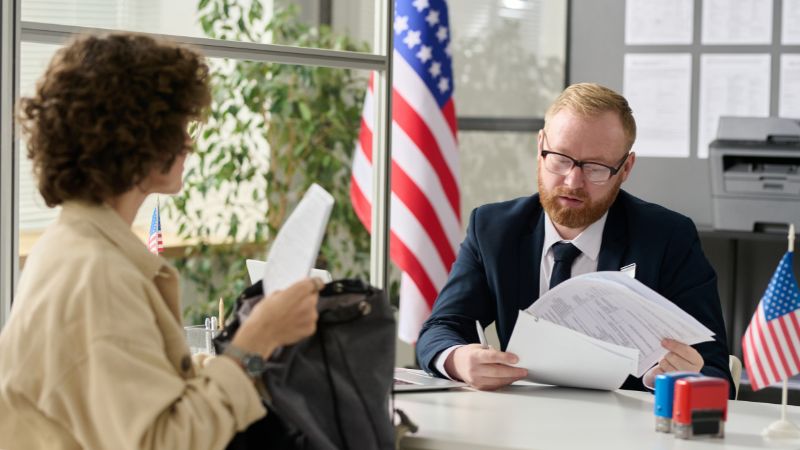
Based on the experience of the First Consulting Group team, one of the common reasons many applications face difficulties is when the Consular Officer needs to re-examine the documents within the visa file to verify the completeness and validity of previously submitted documentation. The Consular Officer may cross-check the applicant’s answers against the information declared in the DS-260 form and related documents in the file.
Common situations that prompt a Consular Officer to review an application include:
In these instances, the Consular Officer may temporarily suspend processing under section 221(g) to request additional documentation (Request for Evidence – RFE) or to conduct further review and verify information before making a final decision. Preparing documents thoroughly and grasping the information declared in the application will help the applicant answer more clearly and reduce the likelihood of receiving requests for evidence or further administrative processing.
US immigrant visa interview questions do not merely revolve around personal information. The Consular Officer may ask about the petitioner, family relationships, settlement plans, and may even cross-check the applicant’s answers with all declared information and previously submitted documents.
If the answers contradict the declared information, the Consular Officer may ask for further explanation or request additional documents for verification. In cases where severe misrepresentation or signs of fraud are detected, the application may be subject to additional document requests or even denied in accordance with immigration law. This is also one of the most common, yet unforeseen, reasons leading to US immigrant visa interview failures.
Five most common questions from the US Consulate:
Experience from hundreds of successful cases demonstrates that immigrant visa approval is not a matter of luck but the result of meticulous preparation. The risk of a US immigrant visa denial can be completely minimized if the applicant clearly understands the process and prepares in the right direction. This holds true for family-sponsored preferences such as Lawful Permanent Resident (LPR) sponsorships or immediate relative categories like spouses, children, or siblings of US citizens. These are prevalent immigrant categories and often require strict verification of family relationships.
Spousal, child, or sibling sponsorship petitions are typically heavily scrutinized regarding family relationships. Therefore, applicants must thoroughly grasp the petitioner’s information, contact history, and all data declared in the application. Understanding the specific characteristics of each family-based category makes preparing answers more natural and consistent.
Pre-interview checklist:

In reality, many applicants do not fail because of a weak case file, but due to confusion when facing unexpected situations during the interview. For instance, the interview usually happens quickly, and sometimes it can be difficult to hear the questions clearly. If the applicant does not fully understand the question, they can politely ask the Consular Officer to repeat it. Requesting to repeat a question helps avoid giving incorrect or off-topic answers. Alternatively, if the interview moves swiftly with multiple consecutive questions, applicants should provide concise, to-the-point answers rather than attempting overly lengthy explanations.
First Consulting Group further notes: individuals scheduled for an interview at the Consulate should review their entire application file at least two weeks before the appointment date. Detecting errors early provides applicants with ample time to make corrections and avoid US immigrant visa interview denials. For applications pending processing or subject to document requests, monitoring notifications from the Visa Center is critical.
What should you bring to a US immigrant visa interview? Below is the essential checklist:
Bring both original documents and photocopies. It is highly recommended to prepare completely to avoid making the Consular Officer wait due to missing paperwork. For applications with long waiting periods, certain documents like police certificates or newly acquired civil documents may need to be updated prior to the interview date.
Consular Officers typically focus on several key content areas to verify accuracy and the relationship between the petitioner and the applicant. Questions often revolve around the following issues:

Thorough preparation and practice help applicants feel more confident and reduce the risk of a US immigrant visa denial. However, without practice, applicants can easily panic when faced with unexpected situations. Following the interview, the timeframe to receive results may vary depending on the specific circumstances.
When the application is complete and requires no further verification, the visa is typically issued shortly after the interview. Nevertheless, in certain cases, the file may require additional time to undergo administrative processing. Thus, applicants should monitor notifications from the Consulate to stay updated on their visa status. If the application is approved without the need for further administrative processing, the timeframe to receive the passport with the visa can range from a few days to a few weeks, depending on each case and current processing times. If the application requires supplemental documents or additional verification before a decision is reached, the Consular Officer will suspend processing and instruct the applicant on providing the necessary documents.
In many instances, the Consular Officer may request additional documentation or require extra time for review. In such events, the applicant must complete the missing paperwork and submit it according to the instructions in the notification. In some cases, the application may be reviewed again once the applicant has fully updated the documentation. Understanding the document supplementation process helps prevent prolonged wait times.
Should you require more information or legal assistance regarding immigration, family-based sponsorship, or complex immigration procedures, please contact First Consulting Group for dedicated guidance and professional handling by our team of attorneys. Connect with us to receive personalized consultation and support throughout your immigration journey.
FOR A FREE CONSULTATION, PLEASE CALL:
– Hotline: (877) 348-7869
– Garden Grove Office: (714) 638-3111
– San Jose Office: (408) 998-5555
– Houston Office: (832) 353-3535
– Vietnam Office: (028) 3516-2118
Disclaimer: All information provided in this document is intended for general informational purposes only and does not constitute formal legal advice. Statistical data and processing timelines reflect the public records available at the time of publication. For precise legal assessments, please schedule a direct consultation with First Consulting Group.
Top Articles

The U.S. immigration process can be intricate, involving detailed legal requirements and procedures. To better address your unique situation, please provide your contact details to arrange a personalized consultation. A member of First Consulting Group’s dedicated team will contact you during business hours to offer expert guidance.

USA
12966 Euclid St., Suite 520, Garden Grove, CA 92840
(714) 638-3111
USA
989 Story Rd., Suite 8075, San Jose, CA 95122
(408) 998-5555
USA
1880 S Dairy Ashford Rd Ste 539, Houston, TX 77077
(832) 353-3535
VIETNAM
8th Floor, Tuoi Tre Tower, 60A Hoang Van Thu St., Duc Nhuan Ward, SaiGon
(028) 3516-2118
VIETNAM
5th Floor, Bao Minh Building, 08 Phan Van Tri St., Ninh Kieu Ward, Can Tho City
(0292) 383-0001
VIETNAM
5th Floor, Viettel Building, 11 Ly Thuong Kiet St., Thuan Hoa Ward, Hue City
(0234) 381-0016
VIETNAM
6th Floor, ACB Building, 218 Bach Dang St., Hai Chau Ward, Da Nang City
0886 00 34 00