
DHS issues final rule changing admission period for foreign students and exchange visitors
minhle
News

A common misconception leads many to believe that holding an invitation letter is sufficient to automatically maximize the approval rate of a B2 visitor visa; however, in practice, numerous applicants still face immediate refusals despite possessing comprehensive paperwork executed by a relative residing lawfully within the United States. First Consulting Group delivers a standardized bilingual English-Vietnamese family invitation letter template, paired with professional guidance on strategic drafting to ensure your application package is flawlessly supported.

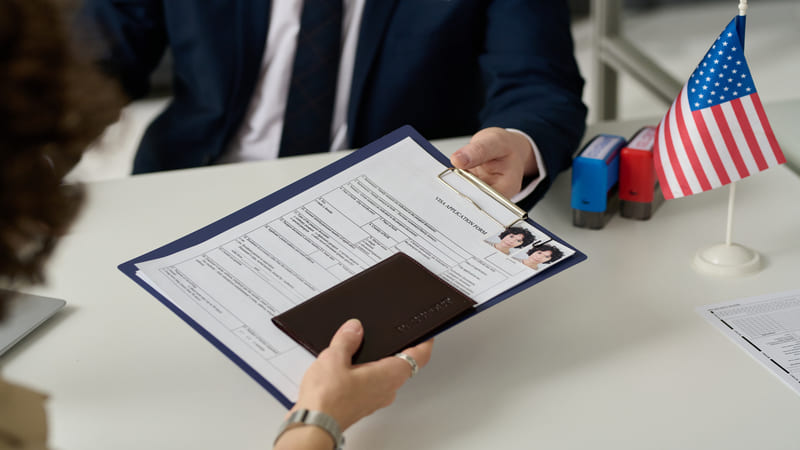
A U.S. family visitation invitation letter is a formal statement authored by a relative residing lawfully within the United States to confirm their relationship with a B2 visa applicant and clarify the exact purpose and projected timeline of the intended visit. Under statutory guidelines enforced by the U.S. Department of State, this is not a mandatory application document. However, it operates as a widely utilized supporting record that many filers integrate into their package to maximize the persuasive weight of their presentation before consular officials.
Is it a mandatory requirement when filing for a B2 visa?
No. The U.S. Consular Section does not mandate the inclusion of an invitation letter when processing a nonimmigrant visitor visa application. The definitive key to a successful adjudication rests on the applicant’s independent ability to demonstrate strong socioeconomic anchors to their home country through stable professional employment, verifiable asset holdings, immediate family ties, and robust, independent financial capability to fully capitalize the journey.
The specific demographics that routinely submit this document encompass parents visiting children who hold U.S. citizenship, siblings visiting professionals working locally under H1B status, or parents visiting international students holding permanent residency. However, regardless of your specific demographic group, the raw content of the letter must be meticulously managed to prevent any perception that the visa applicant is dependent on the inviting party inside the United States. If the text provides excessive detail regarding the relative underwriting the entire cost of attendance, or overemphasizes the family relationship to a degree that implies a permanent stay, the strategy can completely backfire, heightening the officer’s suspicion of immigrant intent under Section 214(b).
Concurrently, the evidential weight of the letter shifts dynamically based on the inviting party’s specific immigration status. An invitation from a U.S. citizen is routinely interpreted as a stable family tie, whereas an invitation from a Green Card holder requires explicit disclosure regarding their duration of residency and current employment tracking. If the letter is executed by an F1 international student or an H1B nonimmigrant professional, the narrative should be strictly restricted to validating the relationship and confirming temporary residential accommodations, completely avoiding references to ongoing financial support to neutralize any perception of dependency.

Primary criteria evaluated by the U.S. Consular Section
An adjudicating consular officer evaluates an invitation letter based on three core pillars:
When these core metrics fail to align seamlessly, the invitation letter ceases to be helpful and instead compromises the credibility of your entire documentation portfolio. Consular officers focus heavily on verifying whether the inviting party possesses the financial capacity to host the visitor; however, they do not accept formalized binding sponsorships, as the B2 classification inherently mandates absolute economic independence from the applicant.
Prior to deploying this template, you must carefully audit the following baseline compliance conditions:
In standard administrative practice, structuring your file involves 3 core phases: validating the legal residency records of the host, aligning the journey’s timeline and goals, and executing a final compliance audit to eliminate data contradictions. When assembling your physical package, the invitation letter should be placed directly behind your Form DS-160 confirmation page and ahead of your personal civil documents to facilitate a logical review sequence for the officer. Adhering to these structural milestones minimizes the risk of a consular misunderstanding regarding your intent.
Here is a detailed sample of a U.S. family visitation invitation letter:
Dear Consular Officer,
My name is [Host’s Full Name], currently residing at [Complete Residential Address in the United States]. I am writing to invite my [Relationship: mother/father/sibling], [Applicant’s Full Name], to visit me in the United States from [Start Date] to [End Date].
The purpose of this visit is to spend time together as a family and tour some local attractions. During the stay, [Applicant’s Full Name] will reside at my home. I understand that [Applicant’s Full Name] will cover all travel expenses independently.
Please find attached my proof of residency and identification. Should you need further information, please contact me at [Phone Number] or [Email Address].
Sincerely,
[Physical Signature] [Host’s Full Name]
Kính gửi Cán bộ Lãnh sự,
Tôi tên là [Tên người mời], hiện đang cư trú tại [Địa chỉ cụ thể tại Hoa Kỳ]. Tôi viết thư này để mời [Mối quan hệ: mẹ/bố/anh chị em], [Tên người được mời], đến thăm tôi tại Hoa Kỳ từ ngày [Ngày bắt đầu] đến ngày [Ngày kết thúc].
Mục đích chuyến thăm là để gia đình sum họp và tham quan một số địa điểm địa phương. Trong thời gian lưu trú, [Tên người được mời] sẽ ở tại nhà tôi. Tôi hiểu rằng [Tên người được mời] sẽ tự chi trả toàn bộ chi phí đi lại.
Xin vui lòng xem giấy tờ chứng minh cư trú và căn cước của tôi đính kèm. Nếu cần thêm thông tin, xin liên hệ tôi qua số [Số điện thoại] hoặc [Email].
Trân trọng,
[Chữ ký] [Tên người mời]
Technical defects within an invitation letter typically cluster around three common vulnerabilities:
Committing these administrative errors damages the transparency of your case file. Highly specific profiles require advanced formatting: if the host operates under an active F1 student visa, the text must emphasize that they are providing temporary residential space only and do not possess the capacity to underwrite the visitor’s finances. If the host has recently immigrated, they must attach certified income statements to dispel any doubts regarding their capacity to host.
Strategic scenarios where compiling an invitation letter is advantageous:
Scenarios where an invitation letter should be omitted from the file:
Core self-audit milestones prior to submission:
If you answer affirmatively to any of these self-audit gates, you must re-evaluate your filing strategy or rewrite the text to achieve full compliance. Remember that a visitation invitation letter is completely distinct from a formal Form I-134 Affidavit of Support—the latter represents a legally binding contract that carries severe financial liabilities and applies exclusively to specialized nonimmigrant visa paths.
An invitation letter is not a magic key that guarantees the issuance of a B2 visitor visa; however, when drafted with absolute precision, it functions as an excellent tool to clarify your programmatic intent before immigration authorities. The core objective is to master its legal boundaries and eliminate administrative errors that could weaken your portfolio. For applicants navigating complex profiles—such as individuals with a history of a prior visa refusal, un-tracked international travel records, or hosts with fluid residency standings—retaining a professional consultation with an immigration expert ensures you deploy a bulletproof, comprehensive filing strategy.
If you require specialized assistance to manage your nonimmigrant files, process visa applications, coordinate permanent residency paths, or handle complex U.S. immigration workflows, connect with the office of First Consulting Group today to lock in your rapid, professional compliance review.
FOR A FREE CONSULTATION, PLEASE CALL:
– Hotline: (877) 348-7869
– Garden Grove Office: (714) 638-3111
– San Jose Office: (408) 998-5555
– Houston Office: (832) 353-3535
– Vietnam Office: (028) 3516-2118
Disclaimer: All information provided in this document is intended for general informational purposes only and does not constitute formal legal advice. Statistical data and processing timelines reflect the public records available at the time of publication. For precise legal assessments, please schedule a direct consultation with First Consulting Group.
Top Articles


The U.S. immigration process can be intricate, involving detailed legal requirements and procedures. To better address your unique situation, please provide your contact details to arrange a personalized consultation. A member of First Consulting Group’s dedicated team will contact you during business hours to offer expert guidance.

USA
12966 Euclid St., Suite 520, Garden Grove, CA 92840
(714) 638-3111
USA
989 Story Rd., Suite 8075, San Jose, CA 95122
(408) 998-5555
USA
1880 S Dairy Ashford Rd Ste 539, Houston, TX 77077
(832) 353-3535
VIETNAM
8th Floor, Tuoi Tre Tower, 60A Hoang Van Thu St., Duc Nhuan Ward, SaiGon
(028) 3516-2118
VIETNAM
5th Floor, Bao Minh Building, 08 Phan Van Tri St., Ninh Kieu Ward, Can Tho City
(0292) 383-0001
VIETNAM
5th Floor, Viettel Building, 11 Ly Thuong Kiet St., Thuan Hoa Ward, Hue City
(0234) 381-0016
VIETNAM
6th Floor, ACB Building, 218 Bach Dang St., Hai Chau Ward, Da Nang City
0886 00 34 00