What is required to build a quality EB-2 NIW project? 4 crucial characteristics to note
minhle
EB-2 NIW Visa
The F-1 visa is designed for international students pursuing full-time academic studies in the United States. This category applies exclusively to students enrolling at institutions officially approved by the SEVP (Student and Exchange Visitor Program). However, this temporary nonimmigrant visa track is not suitable for every applicant. Understanding your eligibility, specific requirements, and the step-by-step workflow will help you avoid costly administrative mistakes. With over 23 years of experience in U.S. immigration consulting, First Consulting Group has analyzed thousands of visa refusals. The vast majority of these denials stem from choosing the incorrect visa track or failing to master key statutory parameters before applying.
Answering “Who is the F-1 visa suitable for?” is a vital preliminary step before initiating your application package. Selecting the correct visa category heavily impacts your success rate because the F-1 track enforces strict regulatory boundaries. Correctly identifying your baseline applicant profile minimizes the severe risk of an automated refusal under Section 214(b) regarding the legal presumption of immigrant intent.
Traditional pupils and university-level students historically experience the highest approval rates. The underlying reason is straightforward: a transparent, age-appropriate academic timeline. An official Form I-20 issued by an SEVP-certified institution anchors the file, building a documentary portfolio that aligns perfectly with consular legal expectations.
The query “Can a high school student secure an F-1 visa to study in the U.S.?” carries a clear, affirmative answer. However, the applicant must satisfy the following statutory conditions:
The target U.S. institution must possess a valid federal license to host international students.
The sponsor must demonstrate sufficient financial capacity to cover all tuition and living expenses for the entire program duration.
The applicant must prove a firm intent to return to their home country after graduation.
The F-1 student visa offers superior operational flexibility compared to the J-1 exchange visitor visa. It does not carry restrictive two-year home-country physical presence requirements, allowing graduates to seamlessly transition into long-term employment tracks, such as the H-1B visa, upon graduation.
Working professionals and individuals with significant gap years face substantial structural hurdles when opening an F-1 visa dossier. Consular officers routinely scrutinize the genuine academic intent of an older applicant, viewing the profile as a potential pretext for unauthorized employment or long-term relocation.
Answering “Is it difficult to secure an F-1 visa after entering the workforce?” depends entirely on objective documentation variables, including:
A direct, logical connection between your current professional career and the proposed U.S. field of study.
Deep-rooted economic and social ties to your country of origin, verified via registered property assets and immediate family structures.
A highly cohesive post-graduation professional plan within your home market.
Under Section 214(b) of the Immigration and Nationality Act (INA), student visa applicants are statutorily mandated to overcome the presumption of immigrant intent. Working professionals must articulate a compelling business necessity for their studies. Formally establishing your intent to depart the United States post-graduation is a non-negotiable legal requirement.
Reviewing the structural differences between the three primary international student categories ensures you select the exact track that matches your educational objectives and future goals:
F-1 Visa: Reserved for full-time academic studies at accredited universities, colleges, high schools, or intensive English language training programs.
J-1 Visa: Designated for approved exchange visitor programs. Specific J-1 categories are bound by the Section 212(e) two-year home-country physical presence rule—requiring the beneficiary to return to their country of origin for 2 years before they can legally adjust status to permanent residency or transition into an H-1B work visa. This restriction is triggered by government funding, specialized fields, or country skills lists.
M-1 Visa: Restricted exclusively to technical, vocational, or non-academic training programs. Crucially, M-1 holders are completely prohibited from changing their status to an F-1 visa while remaining inside the United States. To change tracks, they must exit the country and submit a completely new visa application at a U.S. Embassy or Consulate abroad.
A frequent error made by independent applicants is selecting the incorrect visa classification based on unverified advice. A successful U.S. F-1 visa interview demands absolute clarity on two core pillars: a transparent academic purpose and concrete ties ensuring a return home.
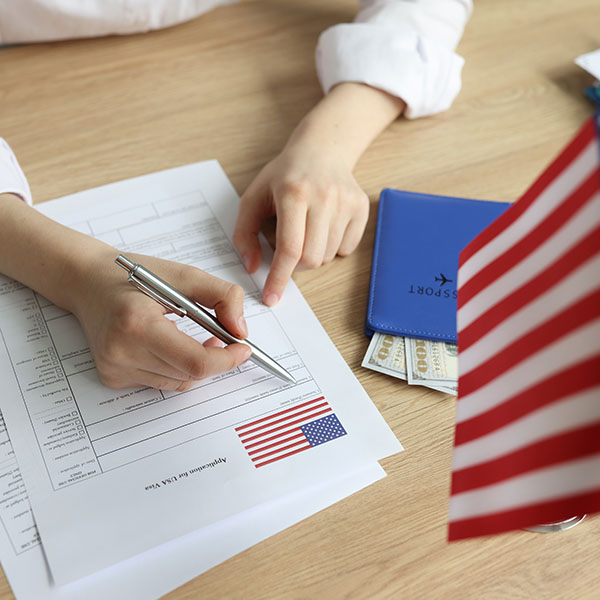
To secure an F-1 visa approval, the dossier must flawlessly satisfy 4 baseline statutory criteria enforced by consular officers:
A valid, unaltered Form I-20 generated by an active SEVP-certified institution.
Clear, objective financial documentation proving the ability to fund all tuition, fees, and living expenses.
Binding social and economic ties guaranteeing your timely return to your home country.
Fulfillment of all baseline academic and language proficiencies required by the hosting U.S. institution.
Financial proof must display transparent asset origins and a reliable funding history. All international student records are systematically managed via SEVIS (Student and Exchange Visitor Information System), making the timely payment of the mandatory Form I-901 SEVIS fee strictly required prior to your scheduled interview date.
Furthermore, Form DS-160 must be filled out with absolute data precision, ensuring perfect consistency with all accompanying physical credentials. The live consular interview represents the single most critical milestone; applicants must articulate their post-graduation career mapping concisely without appearing robotic.
Following entry into the United States, F-1 students fall under the direct regulatory oversight of a Designated School Official (DSO). The DSO is legally mandated by the federal government to monitor your visa compliance, manage your electronic SEVIS record, issue Form I-20 extensions, and authorize off-campus practical training (OPT/CPT). Maintaining proactive communication with your DSO is the ultimate key to safeguarding your lawful nonimmigrant presence.
Failure to legally overcome the presumption of immigrant intent under Section 214(b).
Presenting an ambiguous, illogical, or poorly researched academic plan.
Submitting insufficient financial assets or unverified, suspicious funding sources.

The F-1 visa serves as the foundational stepping stone for your American educational journey. True success is not merely defined by passing the initial interview, but by strategically planning your long-term pathway—including leveraging post-graduation OPT work authorizations and exploring employment-based Green Card tracks for international graduates.
Meticulous preparation at every single step is mandatory. The full-service immigration team at First Consulting Group, holding over 23 years of professional experience, is ready to guide you. Contact our offices today to secure a tailored evaluation and build an optimized visa strategy for your profile.
FOR A FREE CONSULTATION, PLEASE CALL:
– Hotline: (877) 348-7869
– Garden Grove Office: (714) 638-3111
– San Jose Office: (408) 998-5555
– Houston Office: (832) 353-3535
– Vietnam Office: (028) 3516-2118
Disclaimer: All information provided in this document is intended for general informational purposes only and does not constitute formal legal advice. Statistical data and processing timelines reflect the public records available at the time of publication. For precise legal assessments, please schedule a direct consultation with First Consulting Group.
Top Articles

The U.S. immigration process can be intricate, involving detailed legal requirements and procedures. To better address your unique situation, please provide your contact details to arrange a personalized consultation. A member of First Consulting Group’s dedicated team will contact you during business hours to offer expert guidance.

USA
12966 Euclid St., Suite 520, Garden Grove, CA 92840
(714) 638-3111
USA
989 Story Rd., Suite 8075, San Jose, CA 95122
(408) 998-5555
USA
1880 S Dairy Ashford Rd Ste 539, Houston, TX 77077
(832) 353-3535
VIETNAM
8th Floor, Tuoi Tre Tower, 60A Hoang Van Thu St., Duc Nhuan Ward, SaiGon
(028) 3516-2118
VIETNAM
5th Floor, Bao Minh Building, 08 Phan Van Tri St., Ninh Kieu Ward, Can Tho City
(0292) 383-0001
VIETNAM
5th Floor, Viettel Building, 11 Ly Thuong Kiet St., Thuan Hoa Ward, Hue City
(0234) 381-0016
VIETNAM
6th Floor, ACB Building, 218 Bach Dang St., Hai Chau Ward, Da Nang City
0886 00 34 00