U.S. TO MAKE VISA BOND PROGRAM PERMANENT FOR APPLICANTS FROM DOZENS OF COUNTRIES
minhle
News
The immigration journey for married children sponsored by their parents to the U.S. requires patience and precise preparation right from the very first documents. Each stage involves crucial principles that must be thoroughly understood. Based on years of experience handling immigration cases for the immigrant communities, First Consulting Group will accompany your family from preparing the petition, guiding you on how to track the progress of the F3 category, and responding to requests for evidence, until you are successfully reunited in the U.S.
The F3 visa category allows US citizens to sponsor their married sons and daughters, along with their spouses and minor children, for lawful permanent residence in the United States. This category falls under the Family Preference system of the Immigration and Nationality Act (INA), specifically for family members who do not qualify as Immediate Relatives.
As the third preference category, the annual allocation of F3 visas is highly restricted. Only about 23,400 visas are available globally each year, which are further subject to per-country caps. Because the volume of applications consistently exceeds the annual visa limits, a massive backlog is inevitable. This results in an average waiting period of approximately 14 years, and often longer for countries with exceptionally high immigration demands.
Despite the lengthy waiting times, the F3 visa remains the only legal pathway for married, adult children to reunite permanently with their US citizen parents.

To qualify for this visa, both the petitioner and the beneficiary must meet specific criteria.
Requirements for the Petitioner (Sponsor):
Requirements for the Beneficiary (Sponsored Child):

One of the most significant advantages of the F3 visa category is its derivative eligibility, which allows the principal applicant to bring their immediate family to the US. The accompanying family members include:
The estimated timeline for the F3 visa process is roughly 14 years. This timeframe is measured from the date the Form I-130 (Petition for Alien Relative) is properly filed with USCIS until the priority date becomes current and the immigrant visa interview is scheduled.
A frequently asked question from our global clients is: Where does the F3 visa processing stand as of May 2026?
First Consulting Group provides the latest breakdown based on the May 2026 Visa Bulletin published by the US Department of State to help you track your family’s immigration timeline:
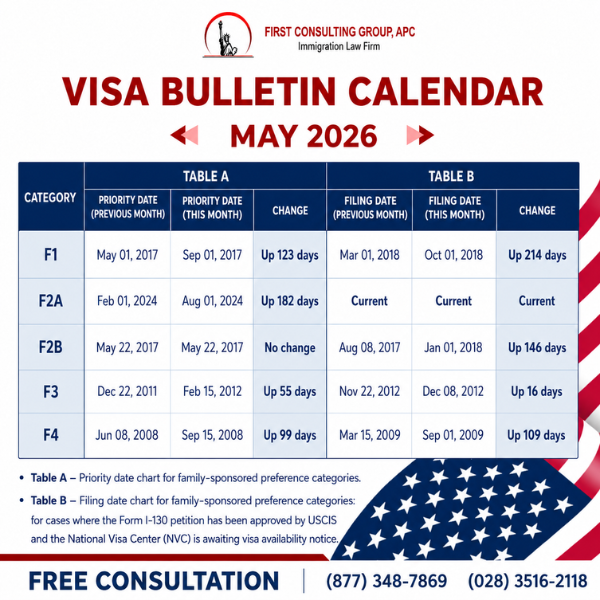
Note: How long the F3 visa process takes depends on the specific agency handling the case and various factors, such as the applicant’s country, the volume of pending applications, whether the paperwork is complete or missing any documents, and any changes to immigration laws (if applicable).
Monitoring Your Petition at USCIS
The United States Citizenship and Immigration Services provides a digital tracking tool via Case Status Online (egov.uscis.gov). By entering your unique 13-character Receipt Number, you can instantly check whether your petition is Received, Actively Under Review, or Approved.
For real-time updates, it is highly recommended to set up an online USCIS account to receive automated email or text notifications whenever there is a milestone update on your case.
Monitoring Chart B – Dates for Filing
Once USCIS approves the Form I-130, the primary waiting period begins. You will need to monitor the monthly Visa Bulletin issued by the US Department of State. Pay close attention to Chart B (Dates for Filing). When the Visa Bulletin date advances past your specific priority date, the NVC will issue an invoice to formally initiate your visa processing.
Tracking Progress at the National Visa Center (NVC)
Once your priority date meets the Chart B cutoff, you will manage your case through the Consular Electronic Application Center (CEAC) portal. In this system, you can fulfill NVC requirements such as paying the immigrant visa fee, completing the online DS-260 application, and uploading required financial and civil documents.
Monitoring Chart A – Final Action Dates
After all required documents are submitted and reviewed, the NVC will issue a notice confirming the case is Documentarily Qualified (DQ). From this point, you must track Chart A (Final Action Dates). When your priority date becomes “Current” on Chart A, the NVC will coordinate with the local US Embassy or Consulate in your home country to schedule your formal visa interview.
The complete immigration workflow involves three distinct institutional phases: USCIS → NVC → U.S. Consulate Interview & Visa Issuance.
Phase 1: United States Citizenship and Immigration Services (USCIS)
During the initial filing stage, the US citizen petitioner must compile and submit the following core documentation:
In addition, documents such as original birth certificates, family photographs spanning various stages of life, or correspondence and messages that demonstrate a close bond are helpful evidence to strengthen the credibility of the parent-child relationship in the petition.
USCIS will focus on reviewing and approving the legal sponsorship relationship in the petition for parents sponsoring married children, while simultaneously establishing the case’s Priority Date; financial factors and visa issuance are not yet assessed during this stage.
Phase 2: National Visa Center (NVC) Processing
Once the priority date is reached, the following critical documentation must be processed electronically:
Phase 3: Consular Interview at the US Embassy or Consulate
The interview is the final and crucial step in the F3 immigrant visa process. The procedure moves quickly, typically lasting only 5 to 10 minutes, and includes fingerprinting, photographing, submitting original documents, and answering questions to verify the family relationship and your plans for living in the U.S.
The Consular Officer commonly asks about the following during the interview:
Leading up to the interview, many applicants feel anxious due to the fear of having their F3 visa denied. Therefore, thorough preparation and a clear understanding of the information will help you feel more at ease and confident.
Note: US government filing and consular processing fees are subject to regulatory updates. Please reach out to First Consulting Group directly for the most current and exact fee schedules.
Only U.S. citizens hold the right to sponsor married children. Therefore, the parent who holds U.S. citizenship must act as the petitioner.
If both parents are U.S. citizens, either parent can file the petition; there is no difference in benefits or processing times. However, please note the following distinctions:
Derivative children (the grandchildren of the petitioner) must be under the age of 21 at the time the visa becomes available to be eligible to immigrate together.
CSPA – Child Status Protection Act: This law allows the child’s age to be recalculated (“frozen”) during the period the petition is pending, reducing the risk of the child “aging out.” However, calculating CSPA eligibility requires precise calculation to ensure the child still meets the under-21 requirement according to immigration regulations.
The interview is the final and crucial step in the immigrant visa process. The procedure moves quickly, typically lasting only 5 to 10 minutes, and includes fingerprinting, photographing, submitting original documents, and answering questions to verify the family relationship and your plans for living in the U.S.
What Does the Consular Officer Ask During an F3 Visa Interview? The Consular Officer commonly asks about the following topics:
Leading up to the interview, many applicants feel anxious due to the fear of having their visa denied. Therefore, thorough preparation and a clear understanding of the information will help you feel more at ease and confident.
First Consulting Group (FCG) is your trusted partner accompanying you on your F3 U.S. immigration journey. With 23 years of supporting the immigrant communities in this field, we have marked our success with over 40,000 successful cases, a dedicated team of over 100 immigration specialists, and more than 100,000 clients who have successfully relocated to the U.S. Owning a network of 7 offices across the U.S. and Vietnam, we are always ready to guide your family step-by-step through the F3 visa process.
FOR A FREE CONSULTATION, PLEASE CALL:
– Hotline: (877) 348-7869
– Garden Grove Office: (714) 638-3111
– San Jose Office: (408) 998-5555
– Houston Office: (832) 353-3535
– Vietnam Office: (028) 3516-2118
Disclaimer: All information provided in this document is intended for general informational purposes only and does not constitute formal legal advice. Statistical data and processing timelines reflect the public records available at the time of publication. For precise legal assessments, please schedule a direct consultation with First Consulting Group.
Top Articles

The U.S. immigration process can be intricate, involving detailed legal requirements and procedures. To better address your unique situation, please provide your contact details to arrange a personalized consultation. A member of First Consulting Group’s dedicated team will contact you during business hours to offer expert guidance.

USA
12966 Euclid St., Suite 520, Garden Grove, CA 92840
(714) 638-3111
USA
989 Story Rd., Suite 8075, San Jose, CA 95122
(408) 998-5555
USA
1880 S Dairy Ashford Rd Ste 539, Houston, TX 77077
(832) 353-3535
VIETNAM
8th Floor, Tuoi Tre Tower, 60A Hoang Van Thu St., Duc Nhuan Ward, SaiGon
(028) 3516-2118
VIETNAM
5th Floor, Bao Minh Building, 08 Phan Van Tri St., Ninh Kieu Ward, Can Tho City
(0292) 383-0001
VIETNAM
5th Floor, Viettel Building, 11 Ly Thuong Kiet St., Thuan Hoa Ward, Hue City
(0234) 381-0016
VIETNAM
6th Floor, ACB Building, 218 Bach Dang St., Hai Chau Ward, Da Nang City
0886 00 34 00