USCIS ISSUES NEW GUIDANCE ON PUBLIC CHARGE INADMISSIBILITY: WHAT APPLICANTS NEED TO KNOW
minhle
News
Every year, thousands of families submit petitions to sponsor their children over the age of 21 to relocate to the United States. However, not everyone fully grasps that they are embarking on a journey that could span anywhere from several years to more than two decades. Depending on the sponsor’s status (U.S. Citizen or Lawful Permanent Resident) and the child’s marital status (single or married), petitions are categorized into F1, F2B, or F3 preferences—each carrying completely distinct regulations, waiting periods, and financial sponsorship requirements. This comprehensive guide from First Consulting Group provides a detailed roadmap and practical insights to help you optimize your petition, reduce wait times, and avoid costly mistakes.
U.S. immigration law clearly defines family-based immigration groups based on biological relationships, marital status, and the petitioner’s status (U.S. Citizen vs. Green Card holder). Because children over 21 are no longer legally considered minors, they do not qualify as Immediate Relatives.Instead, petitions to sponsor children over 21 to the U.S. must wait according to the annual visa quotas allocated by the U.S. Department of State.
To give you a quick reference, here are the average estimated wait times:
Specifically as follows:
A person holding a Green Card (U.S. lawful permanent resident) can open a petition to sponsor their child to the U.S. under the F2B category. This is the visa category that allows parents to sponsor their single children over 21 years old. The current waiting time for processing the F2B category is around 9 years.
U.S. citizens can sponsor children over 21 under two main categories, depending on the marital status of the child:
F1 Category (Single Children Over 21 Years Old):
The F1 category applies to single children from 21 years old and older of U.S. citizens, including those who have never been married, are legally divorced, or widowed but have not remarried.
Specific Conditions:
The F1 category has a larger number of annual visas issued than other categories, and the processing procedures are simpler because there is no need to prove complex family relationships. The relatively short waiting time helps you reunite with your children more quickly.
Important Notes:

F3 Category (Married Children):
In case the child over 21 is married, if the parents are U.S. citizens, the petition will convert to the F3 category (U.S. citizens sponsoring married children). The waiting time can last around 14 years.
Specific Conditions:
Although considered the category with the longest waiting time among all child sponsorship categories, the advantage of the F3 category is that it allows sponsoring the entire small family of the beneficiary, including the spouse and minor children, helping the whole family reunite at the same time in the U.S. However, the financial support requirements are also higher because there are more people in the petition.
Note: If your child in the F3 category was previously married but is currently divorced or widowed and has not remarried, they will be considered single (no spouse) and the petition can convert to the F1 category. This is a big difference because F1 usually has a shorter wait time than F3; updating divorce documents timely to USCIS/NVC will help shorten the waiting time for the family.
To apply, you need to prepare the following documents:
Step 1: Submit the Application to the U.S. Citizenship and Immigration Services (USCIS)
You begin by submitting Form I-130 along with full evidence proving the parent-child relationship and the regulated fees to USCIS.
About 2–4 weeks after USCIS receives the file, you will receive a Receipt Notice by mail, which clearly states the receipt number and the priority date.
The processing time depends on the volume of backlogged cases at each processing USCIS center. You can track the case progress online through the official website of USCIS (uscis.gov) by entering the receipt number written on the receipt notice, or register to receive automatic notifications via email or SMS text message whenever there is an update on the case.
Step 2: Transfer to the National Visa Center (NVC)
After USCIS approves Form I-130, the case will be automatically transferred to the National Visa Center (NVC) for further processing. However, because the F1, F2B, and F3 categories all have annual visa quotas, you will have to wait until your Priority Date comes up according to the Visa Bulletin published monthly by the U.S. Department of State.
The Visa Bulletin has two important charts:
Preparing the Financial Sponsorship File (According to Chart B)
When your Priority Date touches the date written in Chart B, the NVC will send a notification to pay fees (financial sponsorship fee and visa fee) via email or mail. After that, you need to:
After the NVC reviews and accepts all documents completely, the case will switch to Documentarily Qualified (DQ) status. This status means the file has met all requirements regarding paperwork.
Receiving the Interview Invitation Letter (According to Chart A)
When the Priority Date reaches the date written in Chart A, the NVC will officially arrange the interview schedule at the U.S. Embassy or Consulate General via email, including
The specific date, time, and location of the interview
A list of mandatory documents to bring:
Step 3: Vaccinations, Medical Examination, and Interview at the Consulate
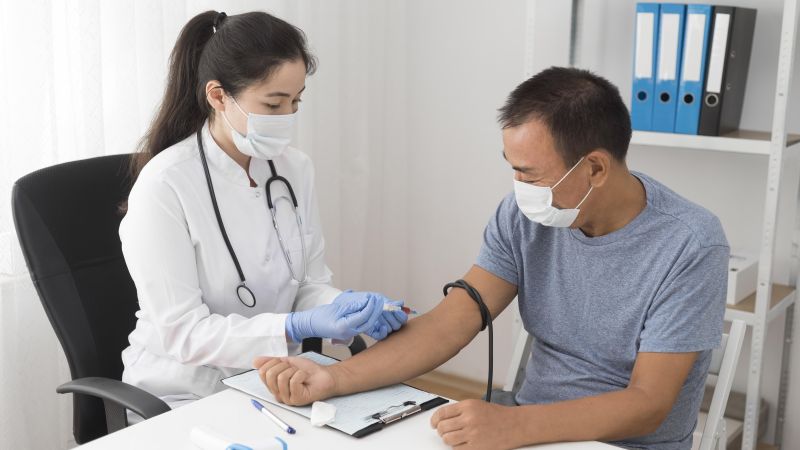
When receiving the interview invitation letter from the U.S. Consulate, the beneficiary needs to complete two mandatory medical procedures before the interview date: full vaccination at the medical facility designated by the Consulate. You should complete the vaccination first, then schedule the medical examination because the doctor will need to verify the vaccination certificate during the exam. The medical examination report will be sealed in an envelope and absolutely must not be opened before submitting it to the consular officer during the interview.
At the interview, the beneficiary needs to bring all documents as requested. The consular officer will verify personal information, check the authenticity of the documents, and evaluate whether the beneficiary is eligible to receive an immigrant visa. The questions usually revolve around the family relationship with the petitioner (to prove this is a real blood relationship), work history, education, plans to live in the U.S. after entry, as well as the financial capability of the petitioner to ensure the beneficiary does not become a public charge for the U.S. government.
Step 4: Visa Issuance and Paying the Green Card Fee
If the case is approved after the interview, the consular officer will retain the passport to stamp the immigrant visa and notify the time to pick it up or send it to your address within 5–10 working days. This immigrant visa is valid for 6 months from the date of issuance, during which the beneficiary must enter the U.S. at least once to activate their permanent resident status.
Before departing for the U.S., you are required to complete the payment for the Green Card issuance fee (USCIS Immigrant Fee) with the current fee of $235 through the online payment portal of USCIS at my.uscis.gov, because the physical Green Card will only be printed and sent to the address in the U.S. after the beneficiary has entered and USCIS confirms that it has received this fee.
During the interview, if the consular officer does not issue the visa immediately but gives you a notification sheet (commonly called a Blue Sheet), this means the case needs to be supplemented with more information or needs more time to be reviewed.
Common reasons:
How to handle:
You need to stay calm and carefully read the items marked on the Blue Sheet. It will clearly state the reason for holding the file and the specific list of documents to supplement. You need to follow the exact requirements and submit supplements according to the instructions (usually sent by mail).
Result:
After you submit enough requirements, the Consulate will check the file again and notify the final result via email or the registered address. The administrative processing time under code 221(g) can range from a few weeks to several months depending on the complexity of the issue.
Step 5: Arriving in the U.S. and Receiving the Green Card
When stepping foot at the U.S. airport for the first time, you will become a lawful permanent resident right at the port of entry after completing inspection procedures with the Customs and Border Protection (CBP) officer. The official Green Card (Form I-551) will be sent by USCIS via mail to the registered address, usually within 90 days from the date of entry. If after this time you have not received the Green Card, you can contact the USCIS hotline at 1-800-375-5283 to check.
After entering and waiting to receive the Green Card, you need to complete the following important procedures:
When sponsoring children over 21 to the U.S. for settlement, the marital status of the child directly affects the sponsorship category and the waiting time. If the beneficiary is legally divorced and has not remarried, they will be considered “unmarried” according to U.S. immigration regulations, thereby opening up opportunities to significantly shorten the waiting time depending on the status of the petitioner.
Case 1: Parents are Permanent Residents (Green Card)
If you are a U.S. permanent resident and your child over 21 is divorced but has not remarried, the child is still considered single and eligible for you to sponsor under the F2B category (Unmarried Sons and Daughters of Permanent Residents). The average waiting time for the F2B category is around 9 years. If the child has their own children (your grandchildren) under 21 and still single, the grandchildren can still be included in the petition to accompany them.
Case 2: Parents are U.S. Citizens
If you are a U.S. citizen and previously submitted a petition to sponsor your child under the F3 category (married child), but later the child gets legally divorced and has not remarried, the petition can be converted to the F1 category (Unmarried Sons and Daughters of U.S. Citizens) — a category with a much shorter waiting time, only around 9 years instead of around 14 years like the F3 category.
To perform the category conversion, you need to contact the National Visa Center (NVC) or USCIS (depending on which stage the file is currently at) and submit documents proving the legal divorce, including: The Final Divorce Decree, a notarized English translation if the document is in a foreign language, and a letter clearly explaining the situation requesting the category conversion for the parent sponsoring a single child over 21.
NVC or USCIS will review and adjust the application category accordingly, helping to shorten the waiting time significantly. Similar to Case 1, if the child has their own children under 21 and still single, the grandchildren can still accompany them in the sponsorship petition.
Note: The category conversion from F3 to F1 or maintaining the F2B category after divorce is only valid when the child HAS NOT remarried. If the child remarries during the waiting period, the petition will automatically return to the F3 category (if the parents are U.S. citizens) or be completely canceled (if the parents are permanent residents because there is no sponsorship category for married children of permanent residents).
With more than 23 years of experience in the field of U.S. immigration and more than 40,000 successfully processed cases, First Consulting Group is proud to be a pioneer in the field of U.S. immigration services. Our team of experts accompanies you through each important step: analyzing the appropriate sponsorship eligibility, drafting accurate forms, preparing full documents and financial evidence, tracking case progress through the CEAC system, and advising on effective interview strategies at the U.S. Consulate.
We commit to comprehensive support from the time the file is opened until you and your family successfully receive the visa, promptly resolving all difficulties arising during the application process. If you need detailed information about sponsoring children over 21, entry permits, or other forms of settlement in the U.S., contact First Consulting Group today for a free reference and to receive professional, rapid support.
FOR A FREE CONSULTATION, PLEASE CALL:
– Hotline: (877) 348-7869
– Garden Grove Office: (714) 638-3111
– San Jose Office: (408) 998-5555
– Houston Office: (832) 353-3535
– Vietnam Office: (028) 3516-2118
Disclaimer: All information provided in this document is intended for general informational purposes only and does not constitute formal legal advice. Statistical data and processing timelines reflect the public records available at the time of publication. For precise legal assessments, please schedule a direct consultation with First Consulting Group.
Top Articles
The U.S. immigration process can be intricate, involving detailed legal requirements and procedures. To better address your unique situation, please provide your contact details to arrange a personalized consultation. A member of First Consulting Group’s dedicated team will contact you during business hours to offer expert guidance.

USA
12966 Euclid St., Suite 520, Garden Grove, CA 92840
(714) 638-3111
USA
989 Story Rd., Suite 8075, San Jose, CA 95122
(408) 998-5555
USA
1880 S Dairy Ashford Rd Ste 539, Houston, TX 77077
(832) 353-3535
VIETNAM
8th Floor, Tuoi Tre Tower, 60A Hoang Van Thu St., Duc Nhuan Ward, SaiGon
(028) 3516-2118
VIETNAM
5th Floor, Bao Minh Building, 08 Phan Van Tri St., Ninh Kieu Ward, Can Tho City
(0292) 383-0001
VIETNAM
5th Floor, Viettel Building, 11 Ly Thuong Kiet St., Thuan Hoa Ward, Hue City
(0234) 381-0016
VIETNAM
6th Floor, ACB Building, 218 Bach Dang St., Hai Chau Ward, Da Nang City
0886 00 34 00